Expert Advice7 min readOctober 02, 2026
How to Prepare for Your Child’s Dyscalculia Diagnostic Assessment
Helping your child feel confident, relaxed and ready for their upcoming dyscalculia assessment.

Emma Hughes
Director Share

A diagnostic assessment for dyscalculia is a positive step towards understanding how your child processes numbers and mathematical information. It helps identify their individual strengths, the areas they find more difficult and the support that may help them.
There is no need for your child to revise or practise maths beforehand. The most helpful preparation is simply making sure they arrive feeling comfortable, rested and reassured.
Before the Assessment
Talk positively about the assessment
Explain that the assessment is not an exam and there is no pass or fail. Your child is not being tested to see whether they are “good” or “bad” at maths.
The purpose is to understand how their brain works with numbers and mathematics, and why they may find some things easier than others.
Do not practise beforehand
There is no need to revise times tables, number bonds, calculations or other maths skills before the appointment.
The assessor needs to see what your child can do independently and the strategies they naturally use. Last-minute practice could make the assessment less representative of their usual mathematical skills.

Reassure them that they will not know every answer
Some of the activities are designed to become increasingly difficult. Your child is not expected to get everything right.
If they do not know an answer, that is absolutely fine. Finding out which activities are difficult, as well as which come more easily, is an important part of the assessment.
Avoid putting pressure on them
Children who have experienced persistent difficulties with mathematics can sometimes feel worried or anxious about maths.
Try to avoid telling your child that they need to “try really hard”, “do their best” or get answers right. Instead, reassure them that all they need to do is have a go and let the assessor see how they approach the different activities.
A helpful message for your child: This is not a test to pass or fail. You only need to have a go, and it is completely fine not to know every answer.
Answer their questions honestly
Your child may want to know what they will be asked to do. Explain that there will be a variety of short activities. Some will involve numbers and maths, while others may look at areas such as memory, reasoning or how quickly they can retrieve certain information.
They may also be asked to explain how they reached an answer. This helps the assessor understand the strategies they use rather than simply whether an answer is right or wrong.
Help them feel rested and comfortable
A good night’s sleep can help with concentration, attention and memory. Keeping bedtime routines relaxed and consistent before the assessment can help your child arrive feeling refreshed.
A balanced breakfast can help them remain focused and energised, while comfortable clothing and footwear can help them feel relaxed and able to concentrate.

On the Day
- Plan your journey: Allow plenty of time for travelling so that your child does not arrive feeling rushed or anxious.
- Bring a drink and snack: The assessment involves sustained concentration, so regular breaks will be offered. A bottle of water and a small snack are recommended.
- Bring glasses if needed: If your child normally wears glasses for reading, schoolwork or distance vision, please remember to bring them.
- Visit the toilet before starting: This can help your child remain comfortable and settled during the assessment.
During the Dyscalculia Assessment
A dyscalculia assessment explores much more than whether a child can complete calculations correctly.
The assessor will look at different aspects of mathematical learning and numerical processing. Activities may explore how your child understands numbers and quantities, counts and sequences numbers, recalls mathematical facts, completes calculations, estimates quantities, understands mathematical language, compares numerical information and approaches mathematical problems.
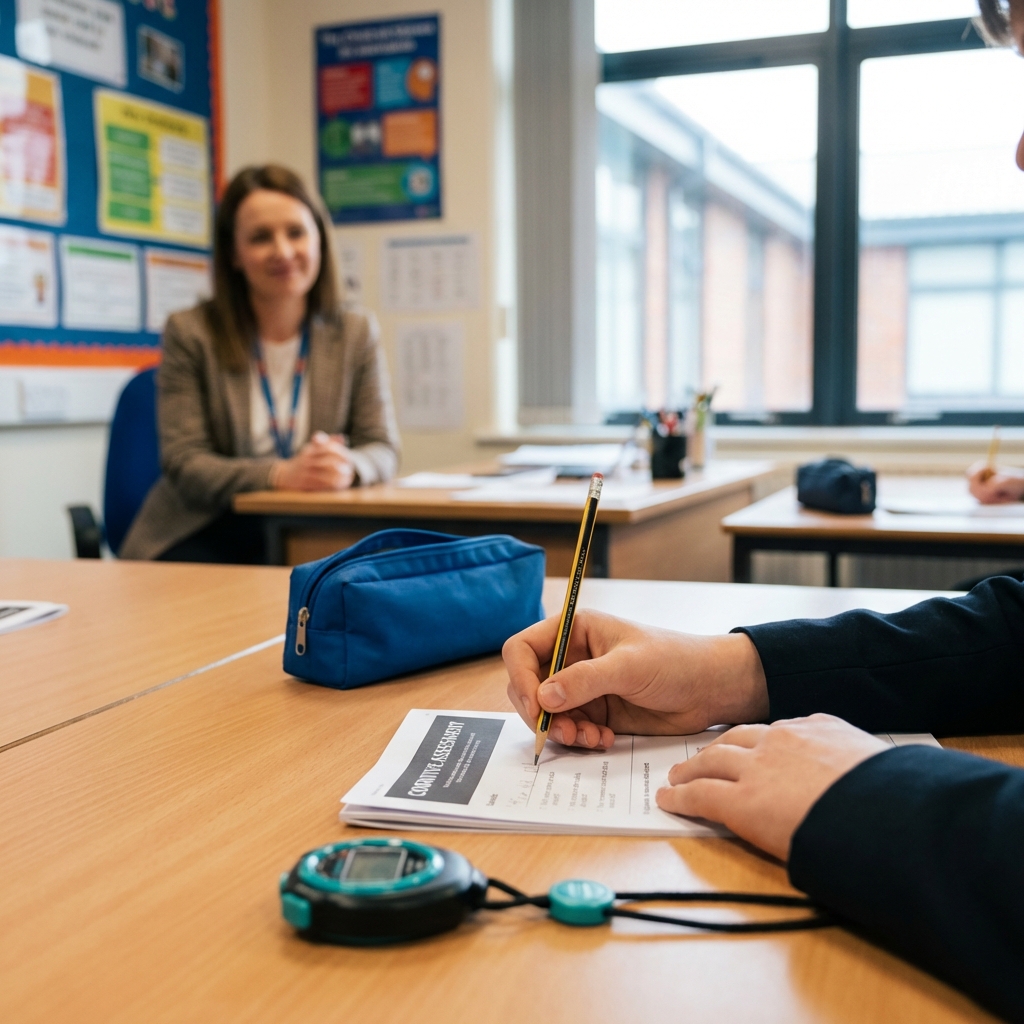
Other activities may examine underlying skills that can influence mathematical learning, such as memory and reasoning.
The assessor will also observe how your child approaches tasks. The strategies they use, whether they rely on counting, how they respond when unsure and the types of errors they make can all provide valuable information about their mathematical learning profile.
Regular breaks will be offered, and your child will be encouraged to work at a comfortable pace. Most importantly, they are not expected to know every answer.
After the Assessment
Following the assessment, the findings will be discussed with you in detail and you will have the opportunity to ask questions.
The assessor will carefully review all of the assessment results alongside the background information provided before reaching a diagnostic conclusion.
You will receive a comprehensive written diagnostic report explaining your child’s individual profile and containing personalised recommendations to support their mathematical learning at home and in education.
Where appropriate, the report will also identify reasonable adjustments and support that may help your child access learning more effectively.
Final Thoughts
Children who find mathematics difficult may have spent a long time believing that they are simply “not good at maths”. A dyscalculia assessment is not about confirming that belief.
It is about understanding why mathematics may be difficult, identifying the child’s strengths and areas of need, and finding appropriate ways to support their learning.
The best preparation is not revision. It is reassurance. Helping your child arrive rested, comfortable and knowing that there is nothing to pass or fail gives the assessor the best opportunity to understand how they really think and learn.
Emma Hughes
AuthorDirector
Specialist educational assessor dedicated to empowering individuals with dyslexia, dyscalculia, and neurodivergent profiles through comprehensive diagnostic assessments.
Read Next

Dyslexia Info
4 min readOctober 01, 2026
Understanding Specific Learning Difficulties (SpLDs)
Learn about Specific Learning Difficulties (SpLDs) including dyslexia and dyscalculia. Discover the signs and how expert diagnostic assessments can help.

Expert TeamSpecialist

Assessments
6 min readOctober 02, 2026
Preparing for Your Remote Diagnostic Assessment
Everything you need to know before your online appointment to ensure it runs smoothly and accurately.
Expert TeamSpecialist