Expert Advice7 min readOctober 02, 2026
How to Prepare for Your Dyscalculia Diagnostic Assessment
Practical guidance to help you feel informed, comfortable and ready for your dyscalculia diagnostic assessment.

Cherrida Crew
Specialist SpLD Assessor Share

Preparing for a dyscalculia assessment can feel daunting, particularly if mathematics has been difficult or stressful for many years. However, there is nothing to revise and nothing to pass or fail.
The purpose of the assessment is to understand how you process numbers and mathematical information, identify strengths and areas of difficulty, and consider the support and strategies that may be helpful in education, employment and everyday life.
Before the Assessment
Do not revise or practise maths beforehand
There is no need to revise times tables, practise calculations or brush up on mathematical methods before the assessment.
The assessor needs to understand how you currently work with numbers and the strategies you naturally use. Practising immediately beforehand may make the results less representative of your usual mathematical functioning.
Remember that it is not an exam
A diagnostic assessment is very different from a school or university maths exam. There is no pass mark and no expectation that every question will be answered correctly. Some activities are deliberately designed to become increasingly difficult.
Finding something difficult is useful information for the assessor. It helps build an accurate picture of your mathematical profile.
Remember: There is nothing to pass or fail. The assessment is designed to understand how you think, not to judge your mathematical ability.
Be honest about difficulties
Many adults develop ways of hiding or working around mathematical difficulties. You may use a calculator for relatively simple calculations, count on your fingers, avoid dealing with cash, rely heavily on a phone for time and directions, or ask somebody else to check numerical information.
There is no need to hide these strategies during the assessment. The assessor is interested in understanding how you approach numbers and mathematics, not judging how you think you should be able to do something.

Think about how maths affects everyday life
Before the assessment, it can be helpful to think about situations in which numbers or mathematics cause difficulty. This might include managing money, understanding bills, budgeting, estimating costs, telling or managing time, remembering PINs and numerical information, following recipes, working with measurements, understanding timetables, planning journeys or estimating distances.
For students, difficulties may also arise when completing mathematical elements of a course, understanding statistics, interpreting graphs and tables, remembering formulae or completing calculations under time pressure.
In employment, difficulties may become apparent when handling figures, recording numerical information, working with measurements, managing deadlines or completing other numerically based tasks. These experiences provide useful context for the assessment.
Complete the background information carefully
Information about your previous experiences of mathematics is an important part of a diagnostic assessment.
Try to provide as much information as possible about difficulties experienced at school, qualifications, additional support, previous assessments and current difficulties. It does not matter if exact details or dates cannot be remembered. Information about longstanding patterns of difficulty can still be valuable.
Try not to worry about maths anxiety
It is quite common for someone seeking a dyscalculia assessment to feel anxious about completing mathematical activities. If this applies to you, tell the assessor. There is no need to conceal anxiety or embarrassment.
The assessment takes place in a supportive environment, and regular breaks can be taken when needed.
Rest and eat beforehand
The assessment requires concentration and can be tiring. A good night’s sleep can help with attention, memory and stamina. Having a meal before the appointment can also help maintain concentration and energy, and bringing a drink and a small snack is recommended.
On the Day
Wear comfortable clothing and bring any glasses you normally use for reading, computer work or other close activities.
There is no need to bring mathematical equipment unless specifically asked to do so. Most importantly, arrive ready to approach the activities naturally rather than trying to demonstrate a particular level of mathematical ability.
During the Dyscalculia Assessment
A dyscalculia assessment looks at considerably more than whether you can complete calculations correctly.
Different activities explore how you understand and process numbers and quantities. These may involve counting and sequencing, comparing numerical information, estimating quantities, recalling mathematical facts, completing calculations, understanding mathematical language and solving mathematical problems.
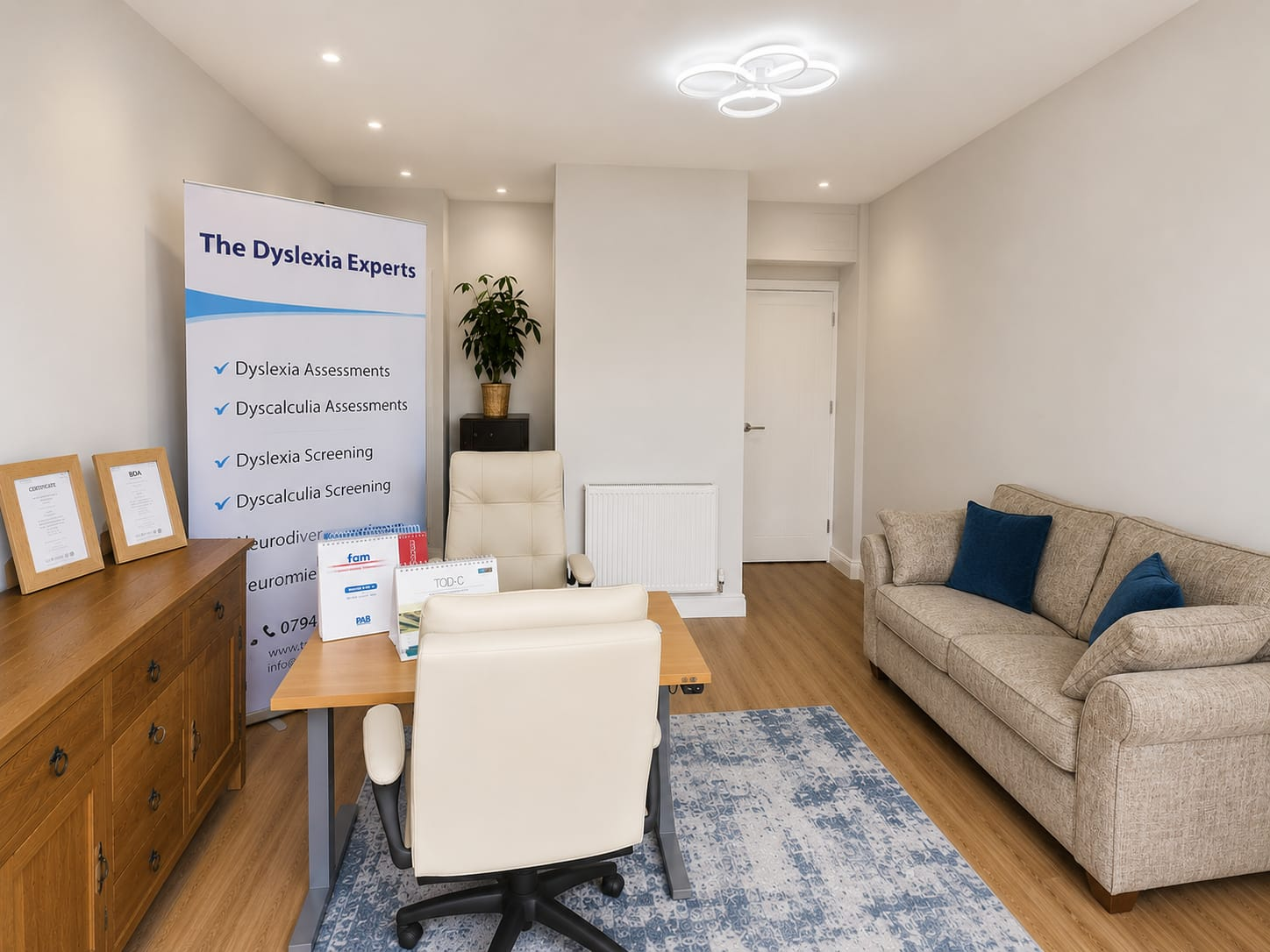
Other activities may examine underlying areas such as memory, reasoning or the ability to hold and manipulate information.
The assessor will also be interested in how you approach tasks. For example, you may rely on counting strategies, take longer to retrieve basic mathematical facts, use written methods for relatively simple calculations or find it difficult to estimate an answer without calculating it precisely.
These observations can be just as informative as whether an answer is correct. There will be opportunities for breaks, and the assessment can proceed at a comfortable pace. If you do not know an answer, it is perfectly acceptable to say so.
After the Assessment
Following the assessment, the findings will be discussed in detail and there will be an opportunity to ask questions.
The assessor will consider the assessment results alongside your developmental, educational and mathematical history and your current experiences before reaching a diagnostic conclusion.
A comprehensive written diagnostic report will explain your profile, areas of strength and difficulty, and provide personalised recommendations.
Depending on your circumstances, recommendations may relate to education, university study, the workplace or strategies for managing mathematical demands in everyday life.
For university students, a diagnostic report may also provide evidence to support an application for Disabled Students’ Allowance where appropriate.
Final Thoughts
For some adults, seeking a dyscalculia assessment follows years of wondering why numbers seem to come easily to other people but remain unusually difficult for them.
Some may have been told at school that they needed to try harder, practise more or learn their times tables. Others may have developed effective strategies that have allowed their underlying difficulties to remain largely unnoticed.
A diagnostic assessment is not about judging mathematical ability. It is an opportunity to understand why difficulties occur, recognise the strategies that have developed over time, identify strengths and areas of need, and consider the support that may make education, employment and everyday life more manageable.
There is nothing to revise and nothing to prove. The best preparation is simply to arrive rested, be open about the difficulties you experience and approach each activity as naturally as possible.
Cherrida Crew
AuthorSpecialist SpLD Assessor
Specialist educational assessor dedicated to empowering individuals with dyslexia, dyscalculia, and neurodivergent profiles through comprehensive diagnostic assessments.
Read Next

Dyslexia Info
4 min readOctober 01, 2026
Understanding Specific Learning Difficulties (SpLDs)
Learn about Specific Learning Difficulties (SpLDs) including dyslexia and dyscalculia. Discover the signs and how expert diagnostic assessments can help.

Expert TeamSpecialist

Assessments
6 min readOctober 02, 2026
Preparing for Your Remote Diagnostic Assessment
Everything you need to know before your online appointment to ensure it runs smoothly and accurately.
Expert TeamSpecialist